Parent Conference Prep Sheet: A One-Page Template That Actually Works
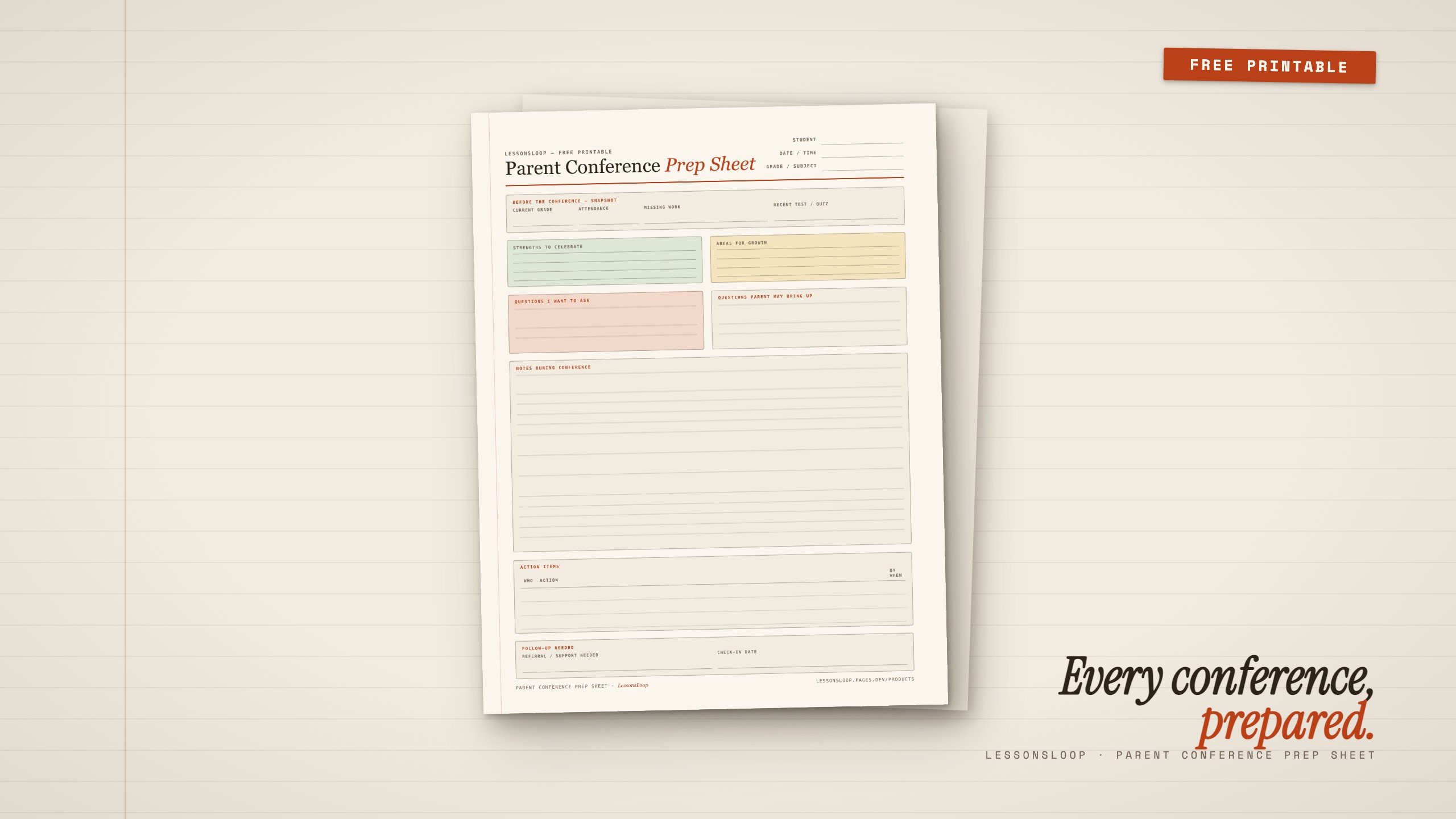
The short answer: A useful parent conference prep sheet covers six things — current grade and data snapshot, two or three strengths to name specifically, one or two focused growth areas, questions you want to ask, space to take notes during the conversation, and a clear action items section with a “who does what by when” structure. Download the free one-pager below.
Download Free Conference Prep Sheet (PDF)No account. No email gate. Direct download.
Why parent conferences go sideways
Parent conferences scheduled for 15 minutes routinely run long, end without clear next steps, or leave teachers feeling like they talked a lot without actually saying the most important things. The common thread is usually preparation — not effort, but structure.
Teachers who struggle with conferences typically over-prepare on content (gathering every grade, every assignment, every observation note from the semester) and under-prepare on outcomes (what do I want this family to leave knowing and agreeing to?). The result is a dense, data-heavy conversation that lacks a clear landing point.
The one-page prep sheet addresses this by forcing specificity before the conference begins. When you have to name two or three specific strengths rather than “doing well overall,” you’ve already done the hard cognitive work that makes the conference productive.
How to use the Parent Conference Prep Sheet
The free printable is a single US Letter page. Here is how to use each section:
Before the Conference — Snapshot
Fill this in while looking at your gradebook, not from memory. Record the student’s current letter grade or percentage, attendance count for the grading period, the number of missing or late assignments, and the most recent test or quiz score. These four numbers give any family an immediate, objective picture — and they give you a factual anchor for the conversation.
The reason to capture four data points rather than one (“she has a B”) is that a grade is a composite. Two students can both have a B for very different reasons — one has consistent 85s across all work, the other has a 95 on tests and a 65 on homework. Those are different conversations requiring different action items.
Strengths to Celebrate
This is not a soft opener to soften a difficult conversation — it is the most important thing you will say. Parents who feel the teacher genuinely sees their child as an individual, not a problem to solve, are dramatically more likely to engage with the growth conversation that follows.
Write two or three specific strengths. “She has a strong vocabulary and consistently chooses challenging books during independent reading” is useful. “She’s a great student” is not. The test: could you say this thing about multiple students in your class, or only this one? If you could say it about anyone, make it more specific.
Areas for Growth
Limit this to one or two things. Not because the student doesn’t have more areas for growth, but because families can only act on a limited number of things, and naming six gaps produces anxiety without direction. Choose the one or two that, if improved, would have the largest impact on the student’s learning this semester.
Frame each growth area with a concrete next step embedded in the description. Not “needs to work on reading comprehension” but “we’re working on summarizing non-fiction — here’s one strategy she can practice at home.” The action items table at the bottom is where you’ll capture the formal commitments, but the growth section should point toward them.
Questions I Want to Ask and Questions Parent May Bring Up
This is the most underused section in most prep systems. Teachers prepare what they want to say but rarely prepare for what they want to learn. Good diagnostic questions for conferences include: “What does she say about school at home — is there anything she finds frustrating that I should know about?” and “Is there anything going on outside school that might be affecting her work?”
The right column — “Questions Parent May Bring Up” — is where you practice. If you know a parent is likely to ask about a grade dispute, a social conflict, or a placement decision, write it down and think through your response before the conference, not during it.
Notes During Conference
Take written notes during the conference, even if it feels formal. Notes serve three purposes: they signal to the family that you are taking the conversation seriously, they give you a record if the conversation is later disputed, and they make the action items section easier to fill in accurately at the end.
Action Items
Every parent conference that does not end with a written action items table has a significant chance of producing zero behavior change on either side. The table has three columns: who, what, and by when. Fill in at least one row before the family leaves. If there is nothing to put in the table, the conference probably didn’t accomplish much.
Typical action items by party:
- Teacher: check in with student about [specific issue] on [date]; send home a progress report by [date]; connect student with [resource]
- Student: attend tutoring on [day]; complete missing work by [date]; try [specific strategy] during independent reading
- Parent/guardian: review planner nightly; contact teacher if [condition]; attend [upcoming school event]
Follow-Up Needed
The final section captures referrals, support system connections, or a follow-up date. If the conference raised a concern that warrants a counselor, reading specialist, or special education coordinator, write it here while it’s fresh. If you agreed to a follow-up check-in, note the date so it doesn’t get lost.
More planning tools: The Parent Conference Prep Sheet is a free standalone. The Sunday Planning Pack includes this sheet alongside a parent contact log (which tracks all family communications across the semester, including conference outcomes), a grading tracker for up to 25 students, and seven other pages — all for $12.
The cadence: one sheet per conference, filed after
Print one sheet per conference. After the conference, either file the physical sheet in a student folder or briefly transfer the action items to your grade book or task management system. The sheet itself is the working document during the conference; what matters afterward is that the action items live somewhere you will actually see them.
For a semester with 25 students and two scheduled conference rounds, that’s 50 sheets total — a small stack that you can sort by student name and reference throughout the year when a parent calls or emails with a concern. Having a written record of what was agreed to in the last conference is genuinely useful and takes no additional time if you’re already filling in the sheet.
Conferences outside scheduled rounds
The Parent Conference Prep Sheet works equally well for informal or unscheduled conversations — a parent who stops by after school, a phone call you initiate about a struggling student, or an email exchange that escalates into a meeting request. Filling in even just the snapshot section, strengths, and growth area before an unscheduled conversation changes the quality of that conversation meaningfully. It takes three minutes.
Read next
For AI tools that help teachers draft parent communication more efficiently, see the MagicSchool AI review — the Family Communication Generator is one of its highest-ROI free tools. For classroom preparation systems that reduce the load across the whole week, the AI lesson planning workflow covers the Sunday prep routine that feeds into a productive week. For a quick way to gather student wellbeing data before conferences, the weekly student check-in slips give you a class-wide pulse check in one printed page. Just want the download link and quick specs? See the prep sheet’s download page.
Common questions
How long before a conference should I fill out the prep sheet?
The day before, not the morning of. Filling it out the night before gives you time to sleep on it — sometimes a strength or concern you didn't think of during prep surfaces when you're not actively trying. Morning-of prep is rushed and tends to produce generic, non-specific notes that don't serve you well during the conversation.
What if I have 10 conferences scheduled back-to-back in a two-hour block?
Fill out all 10 sheets at once the day before, working from your gradebook. Batch the "snapshot" column first across all students, then go back through and write strengths, then growth areas. Batching by section is faster than doing each sheet fully before moving to the next. Budget roughly 5 minutes per sheet, so 10 conferences requires about 50 minutes of prep — manageable the evening before.
Can I use this sheet for student-led conferences?
Yes, with a modification. For student-led conferences, the teacher's role is facilitator rather than presenter. Use the sheet to prep the framing questions you'll ask the student to respond to in front of their family, and use the action items section as normal. The snapshot section becomes a shared reference the student and teacher review together before the conference begins.
What should I do if a parent becomes confrontational during the conference?
The data snapshot section is your anchor. When a conversation becomes emotionally heated, returning to specific, documented information ("I'm looking at the gradebook right now — here is exactly what I'm seeing") moves the conversation from opinion to evidence. The action items section is also useful here: "What would be most helpful to agree on today?" redirects confrontational energy toward problem-solving. If a conference escalates beyond your comfort level, it is always appropriate to ask an administrator to join.