Free Weekly Student Check-in Slips Printable for Teachers
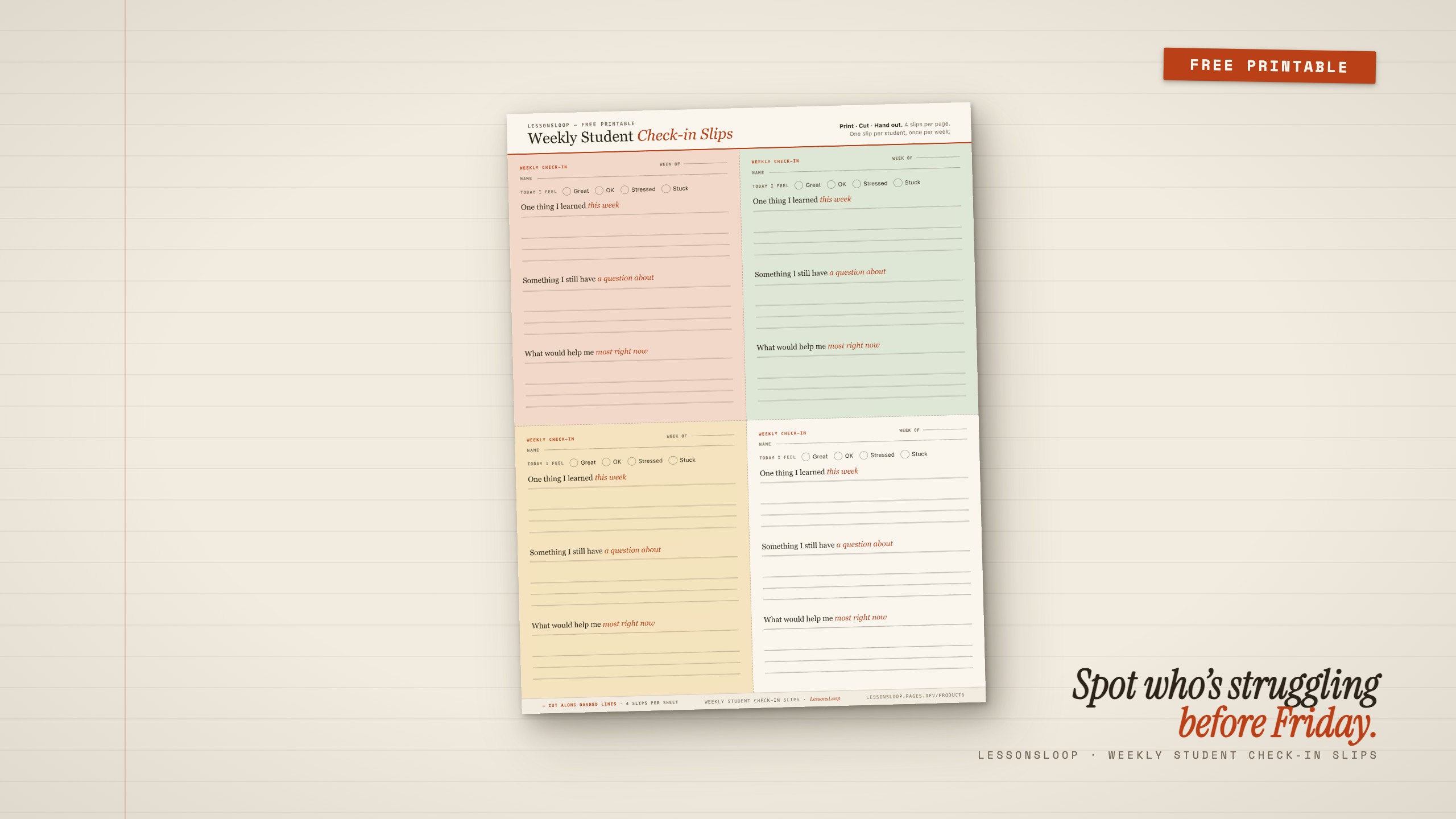
The short answer: Weekly student check-in slips are quarter-sheet forms students complete once a week — typically at the start of Friday or the end of Monday — covering a brief mood self-assessment and three reflection questions. The free printable below gives you four slips per page, designed to print, cut, and hand out in under a minute.
Download Free Check-in Slips (PDF)No email. No account. Direct download. Print as many as you need.
Why a weekly check-in slip works when other feedback methods don’t
Exit tickets, Google Form surveys, and verbal check-ins all have a place in a teacher’s toolkit. But weekly written check-in slips occupy a specific role none of those methods fills as efficiently.
Exit tickets are lesson-specific. They capture what a student understood or didn’t understand about today’s content. They rarely capture how a student is doing more broadly — whether they’re stressed about a family situation, confused about a unit-level concept, or falling behind on homework because of something outside class.
Google Forms require devices and login. A paper slip requires neither. In schools with inconsistent device access, or in any class period where device distribution takes five minutes, a pre-printed slip that students fill in with a pencil is a better tool for a two-minute weekly check-in.
Verbal check-ins don’t scale. A teacher with 28 students cannot have a meaningful one-on-one check-in with each student weekly. A slip that every student fills in simultaneously — while you’re taking attendance or pulling up your lesson materials — gives you qualitative signal from every student in the same two minutes.
What the three questions on the slip are designed to surface
The LessonsLoop check-in slip uses three questions, selected because each one targets a different category of useful signal:
“One thing I learned this week” is a comprehension probe, not a feel-good reflection. When a student writes “I don’t know” or leaves it blank, that’s a data point. When a student names something accurate and specific, that’s a different data point. The question is deliberately low-stakes — it asks for one thing, not a summary, which makes it accessible to students who feel uncertain about their learning.
“Something I still have a question about” is the most diagnostically useful question on the form. Research on metacognition consistently shows that students who can identify what they don’t know are better positioned to close learning gaps than students who can’t. This question also gives you direct input for the next week’s instruction: if 12 out of 28 students write questions about the same concept, you’ve just identified your reteaching priority without a formal assessment.
“What would help me most right now” is the question most likely to surface non-academic needs. Students who write “I need more time on tests,” “I’m really tired,” or “I’m worried about the next quiz” are giving you information you couldn’t get from a gradebook. A student who writes “nothing” for three consecutive weeks and has declining grades is worth a direct conversation. The question also implicitly communicates to students that their preferences about their own learning are relevant — which affects engagement and trust over time.
The mood self-assessment — circling Great / OK / Stressed / Stuck — is intentionally simple. Four options, no written explanation required. A student who circles Stressed or Stuck for two consecutive weeks and shows declining engagement is a student who needs a check-in conversation, not an email home about grades.
How to run the check-in routine effectively
Timing: The most common implementations are Friday-end-of-class (students reflect on the whole week before leaving) and Monday-start-of-class (students reflect on the weekend and set a frame for the week). Both work. Friday gives you data to review over the weekend if you’re planning; Monday gives you data before instruction begins that week.
Time required from students: Two to three minutes. Do not let this expand. If students are writing a paragraph in response to “what would help me most right now,” shorten the allocated time. The slip is a signal-capture tool, not a journaling exercise.
What to do with the slips: Collect them. Skim them that day or the next morning — not to grade, but to flag. You’re looking for: blanks on comprehension questions (potential confusion), repeated Stressed/Stuck mood circles, or requests for help that you can act on quickly. Flag 2–3 slips that warrant follow-up and set them aside for Monday morning conversations.
Storage: A simple system is to keep the week’s slips rubber-banded by class period. If a parent conference comes up mid-semester, you have a qualitative record of how the student described their own learning over the past several weeks — information that’s genuinely useful and rarely captured by gradebooks.
More classroom tools: The Weekly Student Check-in Slips are one of three free printables available on this site. The Sunday Planning Pack ($12) includes student feedback quick-slips in nine different formats, a grading tracker for 25 students, and seven other pages designed for the teacher prep workflow. If the check-in slip is useful, the full pack covers the rest of your planning system.
Adapting the slip for different grade levels
The default slip works for grades 4 through 12. For the lower end of that range (grades 4–5), some teachers simplify by reading the questions aloud and giving students additional time. For high school students, some teachers replace “One thing I learned this week” with “One thing I’m still working to understand” to push toward more metacognitive specificity.
For K–3, a written slip is generally not the right format. The same check-in questions work well as a circle-time verbal routine for primary grades, or as a quick show-of-hands mood check (thumbs up / thumbs sideways / thumbs down) rather than a written form.
What this slip is and is not
This is a classroom management and formative feedback tool — a low-stakes way to maintain a two-way communication channel with every student on a weekly basis. It is not a mental health screening instrument, not a substitute for counselor referrals when students show signs of significant distress, and not a formal assessment.
When a student’s slips over several weeks show a consistent pattern of distress — Stressed circled repeatedly, unanswered questions, declining engagement described in their own words — the appropriate response is a direct conversation and, if the concern warrants it, a referral to a school counselor. The slip surfaces the signal; it does not replace professional judgment about what to do with it.
Read next
For tools that help reduce the prep time that causes teacher burnout in the first place, the AI lesson planning workflow covers how to get a complete lesson plan draft in under 20 minutes using free tools. For the full classroom planning system — lesson planner, grading tracker, sub plans, feedback slips, and more — the Sunday Planning Pack has all 10 pages for $12. Just need the download link? See the check-in slips download page.
Common questions
How many slips does one page print?
Four. The page prints in a 2×2 grid with dashed cut lines. Standard US Letter paper (8.5 × 11 inches) on any home or school printer. Each slip is a half-sheet folded in quarters — roughly 4.25 × 5.5 inches, large enough to write on comfortably.
Do students put their names on the slips?
The slip has a name line, and we recommend using it. Anonymous feedback is less actionable — you cannot follow up with a specific student who circled Stressed and wrote "I don't understand the last unit" without knowing who wrote it. If students are concerned about privacy, remind them that the slips are collected only by you, not shared with other students or posted publicly.
What if students write the same thing every week to get done faster?
This is a real pattern, especially in middle school. Two responses work well. First, occasionally reference specific things students wrote in previous weeks during class: "A few of you asked about how to structure an argument last week, so let's start there." Students who see that their responses affect instruction tend to write more thoughtfully. Second, vary the questions slightly every four to six weeks — the version on the slip is the baseline, but substituting "One thing I want to remember from this unit" or "One thing I wish we had more time on" refreshes the routine.
Is there a digital version of this check-in slip?
The printable is paper-only by design. A digital equivalent using Google Forms takes about 10 minutes to set up and works well for classes with consistent 1:1 device access. The advantage of the paper slip is zero technology friction — no logins, no device distribution, no broken links — which matters for the specific two-minute-at-the-start-of-class use case this slip is designed for.